(in Cantonese)
Me: Grandma, did you remember the times when the Japanese were in China?
Grandma: Oh Eileen, it was so tragic, so terrible, so sad, you cant even imagine..
Me: What did you remember?
Grandma: They killed so many people Eileen, dead bodies everywhere..I was just a little girl then, everyone was running, trying to escape, everyone was yelling that the Japanese were coming. I was running back home, everyone was gone when I got to the house. I ran into the hills crying and yelling for my Mom. For hours, I was crying. Then I saw my cousin and she brought me to where my Mom was. Eileen, they would gather men and forced them to dig big holes in the ground. When they were finished, the Japanese shot them in the head from behind. They were forcing them to dig their own graves. So many people died, women were disappearing. The Japanese randomly grabbed any girl and raped them, tortured and killed them. Your great Aunt, was raped for days, and when she died they tossed her into the river that was filled with bodies….so tragic Eileen, you have no idea…

On December 13, 1937 the Japanese capture the city of Nanjing the former capital of the Republic of China. This six week capture resulted in a mass murder, genocide and war rape. 300,000 Chinese lives were perished during the massive slaughter. 80,000 women were raped, including infants and the elderly. The war was the result of a decades-long Japanese imperialist policy aiming to dominate China politically and militarily and to secure its vast raw material reserves and other economic resources.
After being taken captive from their own homes, women were ofter killed immediately after gang raped, often through mutilation or by stabbing a bayonet, bamboo or other objects into the vagina. Young girls were cut open to allow Japanese soldiers to rape them.There are also accounts of Japanese troops forcing families to commit acts of incest. Sons were forced to rape their mothers, fathers were forced to rape daughters. Monks who had declared a life of celibacy were also forced to rape women. Pregnant women were often stabbed by bayonet and fetuses were tossed out to the side. Thousands were led away and mass-executed in an excavation known as the “Ten-Thousand-Corpse Ditch”, a trench measuring about 300m long and 5m wide.
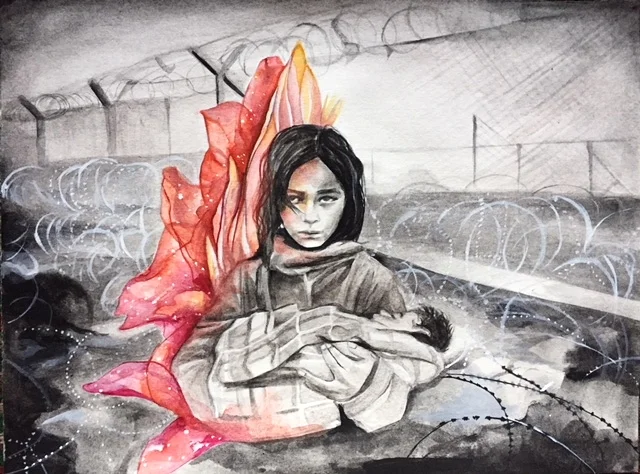
Denial of the massacre has been the staple of Japanese nationalism. Various aspects of the Nanjing massacre have been disputed by Japanese nationalists, who have claimed that the event has been either exaggerated or fabricated for propaganda purposes. It is upsetting to me to have discovered that while I was working on this painting, discussions with others on this event have been mainly unknown. I assume the relationship and the alliance between the United States and Japan shortly after World War II has something to do with why the Nanjing Massacre is unknown to the western world and how it was “swept under the rug”.
During war and armed conflict, rape is frequently used as means of psychological warfare in order to humiliate the enemy and undermine their morale. Military leaders actually encourage their soldiers to rape civilians. War rape may occur in a variety of situations, including institutionalised sexual slavery, war rapes associated with specific battles or massacres, and individual or isolated acts of sexual violence. War rape may also include gang rape and rape with objects. Humanitarian law concerns the maltreatment of civilians and “any devastation not justified by military necessity”. War rape has rarely been prosecuted as a war crime. It was not until 2001 when a confirmed verdict by the International Criminal Tribune for the former Yugoslavia that rape and sexual enslavement are crimes against humanity. Specifically, it was recognised that Muslim women in southeastern Bosnia were subjected to systematic and widespread gang rape, torture and sexual enslavement by Bosnian Serb soldiers, policemen, and members of paramilitary groups after the takeover of the city in April 1992.
The original inspiration for this painting was the ‘Cheongsam’ or ‘Qipao’ which is the traditional Chinese long dress. Inspired by its beauty, cultural value and the evolution of the Chinese feminine expression, I decided to study about the women that wore it during these times. In every inspiration that flows to me, it transforms into a passion of research and study. In my study, I have come to a tragic time in human history that is still relatively unknown to the western world. A tragic story that is rooted in my homeland and still lies painfully in the memory of my family. The ‘Cheongsam’ now represents to me much more than a beautifully made dress. It signifies, the damage and scars Chinese women still bears, the lives lost and the strength of those that still fight to heal, war and the terror against women, but most of all the courage to stand on truth. I hope in my painting, you will learn of a story about a Chinese woman. I hope you will learn about her strength, her love of her culture as she maintains her family, her evolution in her expression as a woman as she have fought and survived through war, her undeniable courage and spirit, in despite of her quiet serenity among the noise that still fights to silence her.
This painting is also a tribute to the author of The Rape of Nanking: The Forgotten Holocaust of World War II, Iris Chang. This book describes the Nanjing Massacre and the atrocities that were committed. She also addresses the issue of the Japanese government not doing enough to redress the atrocities. She was well respected in China for raising awareness of the Nanking Massacre in the Western world. However, she received hate mail mainly from Japanese ultranationalists, threatening notes on her car and she believed her phone was tapped. Suffering from depression, Iris was diagnosed with “brief reactive psychosis” in August 2004. Her battle from depression came to an end in November 2004, when she took her own life.
Any from of acknowledgement, recognition, validation of truth or atonement from the Japanese government is of small importance and incomparable to the tremble in my grandmother voice, the pain that still exists as she recalls her memory as a young girl. There is nothing more close to the truth than that.